

Why Is Your Sales Team Losing Deals in a Slow Market — And What Should Managers Actually Do About It?
By John Anderson, Coach at LotPop John Anderson is a used car operations coach at LotPop with more than two decades in automotive retail, including 24 years on the sideline with the Indianapolis Colts and a career built on building sales and BDC teams that win in any market condition. Connect with John on LinkedIn.
The Direct Answer
When shopper counts drop in the spring lull between tax season and summer sell-a-thon, the losing dealers panic and the winning dealers train. A slow market is not fewer sales — it is fewer at-bats, which means every opportunity has to be worked harder, every sold-car lead has to be recovered instead of abandoned, and every manager has to stop asking "what did you do for me today?" and start asking "how can I help you set up tomorrow?" The dealers who treat this window as preseason — evaluating game film, fixing follow-up language, measuring activities per lead instead of cars per week — are the ones who walk into summer already ahead.
Key Takeaways
- The spring shopper-index dip is not a collapse — it is fewer at-bats, which means every lead has to be worked like it is the last one.
- Most dealerships take one swing per customer (one call, one text, one email, one video) and then walk away. That is not follow-up, that is box-checking.
- When a customer asks about a sold unit, "sorry, it is gone" is the weakest possible response. The pivot is: great news, we have similar or better — and keep the appointment anchor.
- Activity metrics beat outcome metrics. A rep who sold five cars with no activity is set up for a zero next week. Track dials, connects, and appointments per lead.
- Managers who kick customers to the curb at 14 days are running a transactional shop, not a dealership. Do business the way the customer wants to do it — today, next month, or next year.
Why Is Q2 the Most Dangerous Quarter for Used Car Operations?
This week on LotTalk Powered by LotPop, Chris Keene and I sat down with Lou Ramirez and Fred Lennartz from Car Guys Coffee — two of the most respected voices in retail automotive training today. Renaldo was off the grid in Cabo (we will forgive him), so Lou and Fred stepped in and brought the heat.
The setup was simple. The shopper index has been declining since mid-April. We are in that awkward valley between tax season and the summer sell-a-thon. Graduations, end-of-school-year chaos, and consumer hesitation are all pulling traffic down. This is the window where the average dealer panics and the elite dealer gets better.
Fred put it this way: "This is preseason. Season is off — that doesn't mean we don't train. It doesn't mean we don't eat well. It doesn't mean we don't watch game film." Q1, with tax season, was the Super Bowl. Q2 is where you figure out whether you actually know how you won or whether you just got lucky.
That distinction — market-driven versus manager-driven — ran through the entire conversation.
What Is a Sold-Car Lead and Why Are Most Dealers Losing It?
A sold-car lead is any incoming opportunity — phone, digital, walk-in — where the specific vehicle the customer inquired about is already sold or has a deposit on it. In most stores, the conversation dies in three seconds: "Yeah, that one sold. Sorry." Click. The customer hangs up, and the BDC rep moves on like nothing happened.
That is one of the most expensive habits in the used car business.
John made the point on air: if that same customer walked into your showroom and said "I'm here to see the 2021 F-150," no salesperson in their right mind would say "sorry, we sold it three days ago" and walk away. But we do exactly that on the virtual lot every single day.
Fred's pivot was sharp: "They are never going to be able to buy that car — it is sold. But almost every brand made a bunch of cars that look exactly the same with the same options, and they are available if we go look for them. That is great news." The sold car is not the end of the conversation. It is the opening.
Lou added the framework that keeps that pivot from feeling desperate. Before you ever ask for an appointment on the replacement vehicle, you have to know three things about the customer:
- What they want — the vehicle segment (four-door four-wheel-drive truck).
- What they prefer — the specific configuration (Ram with the trailer package, specific options).
- The timeframe and the hold-up — when do they need it, and what has been stopping them from already owning it.
Without those three pieces of information in the CRM, you have nothing to follow up with. That is why most salespeople will not make the call — they did not take the notes.
How Many At-Bats Per Lead Should a Used Car Salesperson Actually Take?
Lou dropped a stat that should make every used car manager uncomfortable. Most dealerships — even big ones doing huge numbers — take about one swing per customer. One call. One text. One email. Maybe one video. Four touches to one person on one day, and then silence.
Meanwhile, the industry data says it takes roughly eight dials just to get a hold of a lead, and 14 to 15 to set an appointment.
That is the gap. The number of opportunities you have is only half the story. The number of real, intentional swings you take at each of those opportunities is where the deals actually live.
Fred's approach to diagnosing a struggling salesperson starts with the numbers: dials per day, connects per dial, appointments per connect. If a rep is dialing heavy but setting nothing, he pulls the call recordings and searches for a single word — "appointment." You will be shocked how many sales conversations never include it.
What Should a Used Car Manager Actually Watch in the Game Film?
Here is the part that every sales manager needs to sit with.
Most sales meetings sound the same: you disappointed me, you missed the shop, we did not hit the number. That is disappointment disguised as leadership. Lou's phrase — and it is worth writing on the sales office whiteboard — was this: replace disappointment with direction.
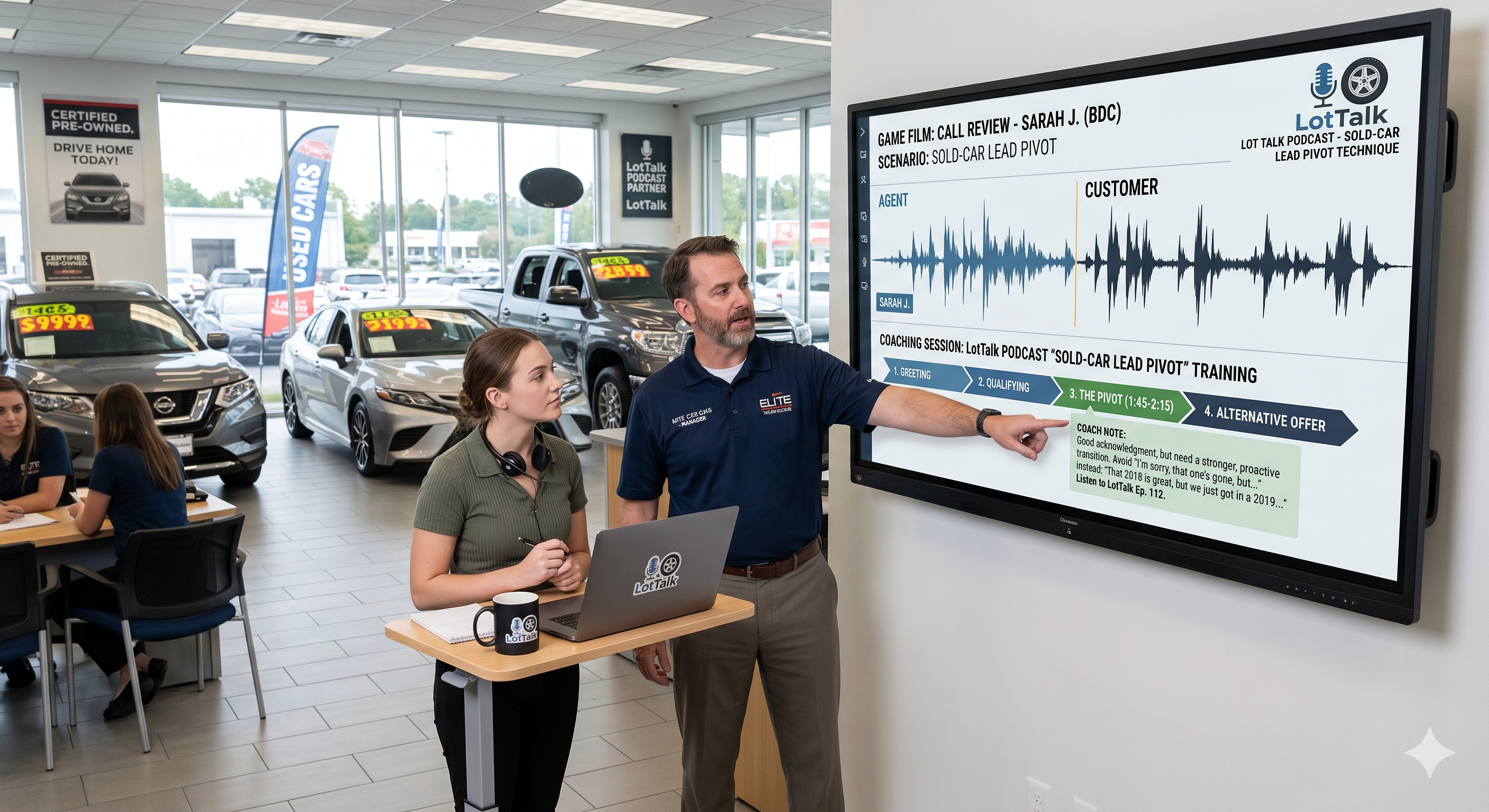
Game film is not about cataloguing mistakes. It is about finding the two or three things your top performer is doing on every call that your bottom performer is never doing. Then you duplicate the behavior, not the personality. You do not coach a quarterback the way you coach a running back. You do not coach Fred the way you coach Lou.
Specifically, here is what to listen for:
- Did the word "appointment" get used at all? If not, you have a language problem, not a skill problem.
- Did the rep ask what the customer wants versus what they prefer? Those are two different questions, and skipping the second one is why follow-up notes are thin.
- Did the rep present options or dictate outcomes? "Are you available during the week or during the weekend? Morning or afternoon?" converts. "When can you be here?" does not.
- On a sold-car call, did the rep pivot or fold? The pivot is: lock the appointment while you are still "checking availability," then deliver the great-news reframe when you confirm.
Why Are Dealers Kicking Customers to the Curb at 14 Days?
This one made John's eyebrows go up on air. We have walked into dealerships — big ones — where the general manager's policy is to kill the lead at 14 days. No activity, no reply, customer is gone. There are CRM vendors out there actively coaching that behavior.
It is indefensible.
The 14-day kick is a follow-up policy that flags an unconverted lead as dead after two weeks of no response, removing it from active rotation. It treats every customer as a today-buyer or a non-buyer, with nothing in between. The math does not work. If a customer tells you they are six months out from buying, "six months" routinely becomes "six days" the moment life changes — a lease ends, a transmission blows, a spouse totals a car. If you are not in front of them when that happens, somebody else is.
Lou and Fred's framework here is simple: do business the way your customer wants to do business. If that means six months of periodic, relevant touches — a market update, a new-arrival note, a price-change alert on something they were watching — that is what you do. The salesperson's job is not to ask every 14 days "are you still in the market." That is two guaranteed don'ts:
- Don't ask if they are still in the market.
- Don't ask if they are still interested.
Both questions are lazy, and both invite a no. Make suggestions. Put options in front of them. Lead them into choosing.
How Should Dealerships Present Digital, In-Store, and Hybrid Buying Options?
One other thread worth pulling. A LotPop dealer partner has built a specific front-end habit into every incoming lead: they ask the customer, point blank, how they want to transact.
If the customer is two miles away: "Are you looking to do this completely online and have the car brought to you, or are you gathering information before you come in?"
If the customer is 200 miles away: "Would this be a fun day trip for the family, or would you rather handle the bulk of it digitally and we deliver?"
Fred called this out as one of the smartest moves a store can make. The moment a customer starts picking between options, they are moving into the buying process. And the dealer that says yes to all four configurations — fully digital, hybrid, in-store start and digital finish, in-store start with digital delivery — wins more deals because they are removing friction instead of dictating a workflow.
If your store is not doing at-home deliveries and digital paperwork in 2026, you are not behind the curve — you are six years behind it.
The Bottom Line
This is not a soft market. It is a training market. The shopper index is down, but that just means every at-bat matters more, every sold-car lead has a second life if you know how to pivot, and every activity number matters more than the outcome it produced. Stop managing for today's scoreboard and start managing for the book of business you are building for next month, next quarter, and next year. The managers who watch game film, fix their language, and lead with direction instead of disappointment are the ones who walk out of Q2 stronger than they walked in.
Frequently Asked Questions
What is a sold-car lead in used car operations? A sold-car lead is any incoming opportunity where the specific vehicle the customer inquired about has already been sold or has a deposit on it. Most dealerships mishandle these by ending the conversation — the correct move is to pivot the customer to similar or better inventory while still anchoring an appointment.
How many follow-up attempts should a salesperson make per lead? Industry benchmarks suggest it takes roughly eight dials to connect with a lead and 14 to 15 to set an appointment. Most dealerships only take one to four touches per customer across all channels combined, which is why so many opportunities are lost to competitors doing deeper follow-up.
What should a used car manager listen for when reviewing game film? Focus on language and activity, not just outcomes. Listen for whether the rep used the word "appointment," whether they asked what the customer wants versus what they prefer, whether they presented two-option choices instead of open-ended ones, and whether they pivoted effectively when the original vehicle was unavailable.
Why is a 14-day lead kill policy hurting dealerships? The 14-day kick treats every customer as either a today-buyer or a non-buyer, which ignores the reality that most used car purchases happen on the customer's timeframe — not the dealership's. Customers who say they are six months out often buy in six days when life changes, and the dealership that stayed in front of them wins that sale.
What is the difference between market-driven and manager-driven sales? A market-driven dealership lives and dies by external conditions — when traffic drops, sales drop. A manager-driven dealership trains, evaluates, and executes the same fundamentals regardless of market conditions, which produces consistent results through both peak seasons and slow periods.
How should dealerships present digital versus in-store buying options? Ask the customer upfront how they want to transact — fully digital, in-store, or a hybrid of both. Saying yes to all configurations (digital start with in-store finish, in-store start with home delivery, fully remote, fully in-person) removes friction and signals respect for the customer's time, which is the most valuable asset they bring to the deal.
What three questions should every sales rep ask before setting an appointment? What do you want (vehicle segment), what do you prefer (specific configuration and options), and what is the timeframe plus hold-up (when do you want to transact and what has been stopping you). Without those three pieces of information, CRM notes are useless and follow-up calls have nowhere to go.
Why is "are you still in the market?" the wrong follow-up question? It is a lazy, closed-ended question that invites a no and signals you have nothing new to offer. Instead, lead with relevant information — a new arrival, a price change, a market update on something they were watching — which shows you remembered them and have been working on their behalf.
Want to Go Deeper?
- Related read: How LotWalk by LotPop Fixes Your BDC's Follow-Up Problem — our deep dive on closing the gap between opportunities and connects.
- Ready to see your numbers? Request a free inventory and process assessment from LotPop — we will pull your data and show you exactly where your at-bats are leaking.
- Listen to the full episode on the LotTalk Podcast page and subscribe to Car Guys Coffee wherever you get your podcasts.